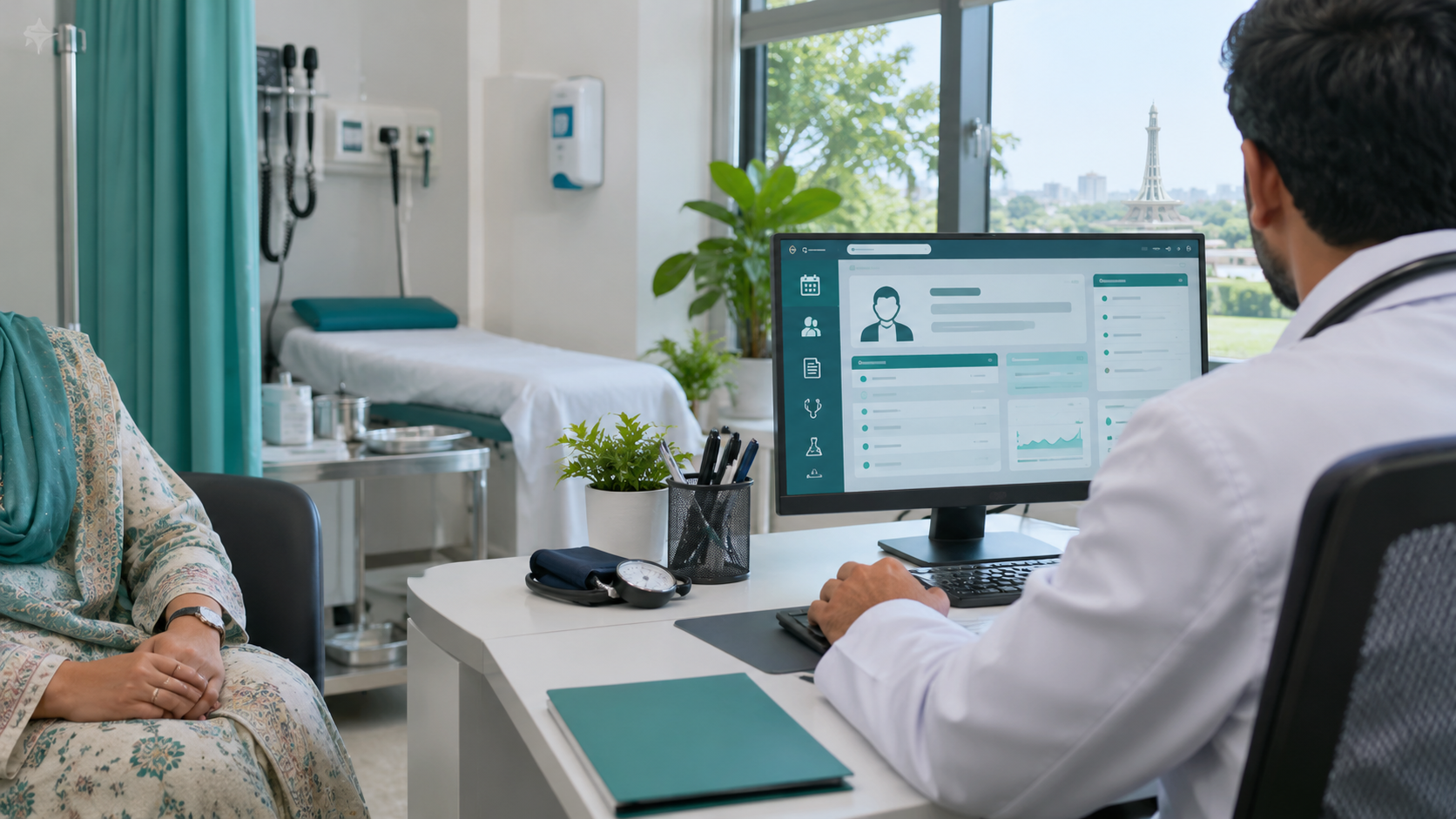
IntelliSist AI Technology: Clinical Intelligence Software for Hospitals
Explore IntelliSist AI technology for clinical documentation, physician-led decision support and connected hospital workflows.
IntelliSist helps clinical teams bring patient information together without removing the doctor from the decision. Developed by D-RIGHT Technologies, the platform is designed for healthcare settings where consultation notes, medical histories, investigations and prescriptions need to remain clear, accessible and connected.
Reliance Hospital in Bahria Town, Rawalpindi, is using IntelliSist in its AI-assisted outpatient workflow. The hospital's deployment is a relevant example of how clinical software can work alongside medical professionals. Specific features enabled at each site depend on configuration and local approval.
What is IntelliSist AI technology?
IntelliSist is clinical intelligence software intended to support healthcare professionals. It can assist with structuring documentation and presenting relevant information during care. It is not an automated doctor or a replacement for a consultation. The treating physician evaluates the patient, decides which findings matter and authorises investigations, diagnoses and treatment.
A good clinical record connects what the patient reports with what the doctor observes and decides. IntelliSist aims to support that connection through a digital workflow that can be reviewed by authorised members of the clinical team.
How the physician-led workflow works
1. Capture and organise the consultation
Depending on the enabled modules, clinicians can enter information through typing or voice documentation. Draft notes should be checked and edited before they become part of the medical record.
2. Review clinical context
Available patient history, existing notes and investigation results may be shown together when integrations and permissions are in place. The aim is to make relevant information easier to review, not to imply that every data source is always complete.
3. Consider clinical support prompts
An appropriately configured decision-support workflow may flag items that deserve attention, such as a possible inconsistency or medication safety concern. A prompt is a reason to review; it is not a final diagnosis.
4. Confirm the treatment plan
The physician remains accountable for clinical interpretation, prescribing and patient communication. Other clinical staff follow authorised instructions and their own professional responsibilities.
Built around patient safety and clinical judgement
Healthcare AI must be assessed for accuracy, limitations, privacy and reliability. No alerting system can identify every risk, and software suggestions can be incorrect or incomplete. D-RIGHT's approach places clinician oversight at the centre of the product's intended use.
Before a hospital enables a new module, its own team should review workflows, user permissions, audit records, downtime procedures and the process for correcting an inaccurate note or prompt.
Clinical documentation and team coordination
Structured notes can help clarify symptoms, findings, next steps and follow-up instructions. When authorised integration is available, connected records can also support continuity between outpatient and other hospital departments. Availability of laboratory, emergency or inpatient modules must be confirmed for each installation before it is advertised.
Who should consider IntelliSist?
Hospital leadership can evaluate the platform for clinical workflows, while doctors may be interested in documentation support and the presentation of relevant clinical information. Information technology, governance and privacy teams should review integration requirements before implementation. Procurement decisions should rely on product demonstrations, validation evidence and a clearly defined scope, not broad claims about AI accuracy.
See how IntelliSist fits your hospital
D-RIGHT Technologies can discuss the intended use, modules, technical requirements and demonstration process with authorised healthcare decision-makers. Request a demonstration through D-RIGHT's approved contact channel. Do not send identifiable patient records through a public enquiry form.
Frequently asked questions
Is IntelliSist a replacement for a doctor?
No. IntelliSist supports clinical workflows, while healthcare professionals remain responsible for assessment and treatment.
Is IntelliSist used at Reliance Hospital?
Reliance Hospital has publicly announced its use of IntelliSist in its AI OPD initiative. The active feature scope should be confirmed with the hospital.
Can it integrate with an existing hospital system?
The product is designed around connected workflows; compatibility must be assessed against the hospital's actual software, data structure and security requirements.
Does it guarantee accurate diagnosis or prevent all prescription errors?
No. Software support is subject to limitations and cannot replace professional review.
Explore related IntelliSist features
Read more about the individual IntelliSist capabilities in clinical decision support, medical documentation, medication safety and hospital integration.
Additional implementation guidance
What a hospital can assess during a demonstration
A practical IntelliSist demonstration should follow one clinical encounter from initial history to the final reviewed note. Hospital buyers can ask to see where patient information enters the workflow, where a doctor can edit the record, and what happens when a suggested prompt is inappropriate. The purpose is to understand a working process rather than judge the product by a list of features.
A useful discussion covers the software version, modules included in the proposal, clinical responsibilities, training requirements, data access and support. If the hospital already has a digital record system, the technical team should establish which interfaces are available and which would require development. No vendor should assume that all modules work immediately in every hospital.
IntelliSist and clinical AI in Pakistan
Hospital teams in Pakistan may work with paper notes, separate departmental software or a common hospital information system. IntelliSist technology is intended to support clinicians in reviewing and organising clinical information across these settings, but its performance depends on implementation. It should be evaluated against the hospital’s own documentation standards, safety procedures and clinical governance.
For a real-world example, Reliance Hospital has announced IntelliSist as part of its AI-powered OPD in Rawalpindi. This is a hospital deployment context, not proof that every product capability is enabled. Hospitals considering IntelliSist software should request a demonstration with the functions and integrations included in their own proposed installation.
Key questions for hospital leadership
- What is the precise scope of the deployment, and which features are already validated?
- Which steps require clinician approval, and how are disagreements with AI prompts documented?
- What data security, access, consent and retention controls are in place?
- What training, downtime processes and support arrangements are included?
- What practical measures will the hospital use to evaluate usability and documentation quality?
Speak with D-RIGHT about IntelliSist
Contact D-RIGHT Technologies through its official website to request a demonstration, confirm active modules and discuss the needs of your hospital. Use demonstration data rather than identifiable patient records.